Twelve Seats, Empty: How the Vanishing Jury Is Handing Prosecutors a Blank Check
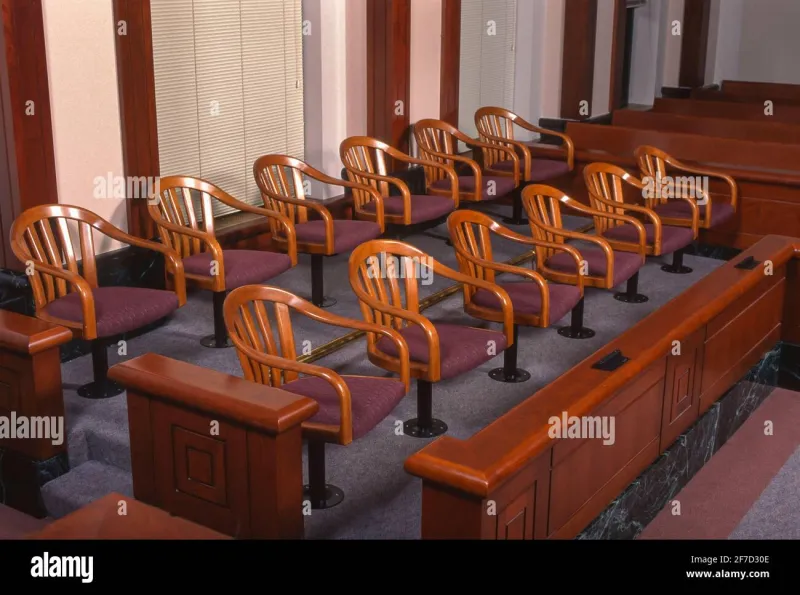
Photo: empty jury box in American courtroom, via c8.alamy.com
A Right That Requires Citizens to Exist
The Sixth Amendment guarantees more than a fair trial; it guarantees that ordinary citizens — not judges, not bureaucrats, not career prosecutors — stand between the state and the accused. But a guarantee is only as strong as the people willing to show up for it. Across the United States, jury participation is quietly collapsing, and with it, the last meaningful check on prosecutorial discretion.
The numbers tell a sobering story. Roughly 95 percent of criminal convictions now arrive by plea bargain rather than verdict. Federal courts have embraced video arraignment and, in some jurisdictions, online plea portals that let defendants resolve charges without ever standing in a courtroom. Each shortcut is efficient. Each one also removes another occasion on which twelve citizens might ask an uncomfortable question.
The Original Check on Power
The framers understood the jury as a political institution, not merely a procedural one. John Adams called trial by jury 'the heart and lungs of liberty.' Its radical premise: the government must persuade your neighbors before it may imprison you. And the jury's power was never limited to weighing facts. Juries historically retained the authority to acquit even when the law favored conviction — the practice known as jury nullification, invoked by colonial jurors resisting the Crown and by northern jurors refusing to enforce the Fugitive Slave Act.
That history is inconvenient for prosecutors, which is why it is rarely mentioned in courtrooms today. Judges routinely instruct jurors that they must apply the law as given, and prospective jurors who volunteer their knowledge of nullification are often struck. The result is a jury system that pretends to be a check on power while being trained out of any habit of exercising it.
Efficiency Is Not Justice
Defenders of the modern plea system point to crushing caseloads. Fair enough — but efficiency arguments have a way of swallowing the constitutional project entirely. A defendant who takes an online plea deal never benefits from community oversight. A prosecutor who never faces a jury never faces persuasion. The incentive structure tilts toward overcharging, because the threat of trial has become a hollow bluff that almost no one calls.
Meanwhile, the demographic breadth of jury pools has narrowed. Source lists built from driver's license and voter rolls miss the young, the transient, and the poor. Those who do receive summonses increasingly seek exemptions, and courts, desperate to fill panels, grant them. What remains is a smaller, less representative cross-section — and a widening gap between the community and the verdicts rendered in its name.
Rebuilding the Citizen's Bench
Restoring the jury as a living institution requires deliberate reforms:
- One-trial, one-vote service. States like Texas have experimented with letting prospective jurors confirm whether their service is actually needed, respecting their time and reducing exemptions.
- Pleas with a jury's fingerprints. Some jurisdictions now require a judge, and in rare cases a panel, to review plea agreements for factual basis — a modest but meaningful reintroduction of community oversight.
- Honest juror education. Civic groups such as the Fully Informed Jury Association have pushed for states to acknowledge the full scope of juror authority. At minimum, high school civics should teach what the jury was designed to do.
- Broader source lists. Drawing pools from tax rolls, utility records, and public assistance files makes panels genuinely representative.
Liberty Needs Spectators Who Become Participants
Freedom is not self-executing. It survives because citizens accept the inconvenience of a summons, the tedium of testimony, the weight of a verdict. Every American who ducks jury duty — and every court that makes jury duty easier to avoid — narrows the space between the accused and the state. Twelve seats, filled by informed neighbors, remain the most democratic institution this republic has. The question is whether enough of us are still willing to sit down.